










5 Interior Design Lessons Inspired by the 2026 LACMA Art+Film Gala
Some spaces are beautiful at first glance while others stay with you. They draw you closer to notice the texture of a surface, the way light changes a colour or how a single image can alter the mood of an entire room.
This November, those creative worlds meet in Los Angeles at the 2026 LACMA Art+Film Gala. Held on November 7th, the 15th annual gala will honour visual artist Vija Celmins and filmmaker Denis Villeneuve, bringing together figures from art, film, fashion and entertainment in support of the Los Angeles County Museum of Art.
For interior designers, the occasion presents an interesting question: What can the worlds of art and film teach us about creating a room? Quite a lot, as it turns out.
What Is the LACMA Art+Film Gala?
The Los Angeles County Museum of Art established the Art+Film Gala in 2011 to celebrate the relationship between visual art and cinema while supporting LACMA's efforts to make film a more integral part of its curatorial programming.
LACMA trustee Eva Chow and actor Leonardo DiCaprio return as co chairs for the 15th consecutive year in 2026. Gucci, which has supported the event since its inception, continues as presenting sponsor.
For 2026, LACMA brings together two creatives whose practices offer very different approaches to visual experience: Vija Celmins and Denis Villeneuve.
Vija Celmins and Denis Villeneuve: Two Ways of Seeing
Vija Celmins is known for extraordinarily detailed representations of the natural world. Ocean surfaces, night skies and expansive natural imagery become subjects for close observation. There is an intimacy to this approach. Something enormous can be reduced to a surface, yet still retain a remarkable sense of depth.

Denis Villeneuve approaches visual storytelling from another direction. His films are recognized for immersive environments where architecture, landscape, scale, light and atmosphere become integral to the story. The environments do not simply contain the action. They help establish how the audience experiences it.

5 Interior Design Lessons From Art and Film
1. Look at Nature More Closely

The most interesting references emerge when we look more closely at the qualities of a landscape rather than simply reproducing its imagery.
Consider the horizon disappearing into mist. The irregular movement of water. The subtle transition between sky and sea. These moments are less about motif and more about atmosphere.
Morning Mist Ocean by 17 Patterns explores this idea through a large scale landscape wallcovering translated from an original air painting. Land, sea and sky dissolve into one another across a cool blue grey palette, creating the quiet impression of a landscape emerging at dawn.
For designers, this is an opportunity to think beyond botanical motifs when bringing nature indoors. Landscape can become colour, movement, depth and visual stillness.
2. Think in Scale

Scale changes perception and cinema understands this instinctively. A vast landscape can make a figure feel small. An immense architectural form can create tension before a character says a word.
Interior design works with the same relationship where a small repeating pattern creates one experience.
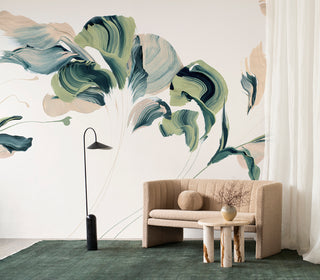
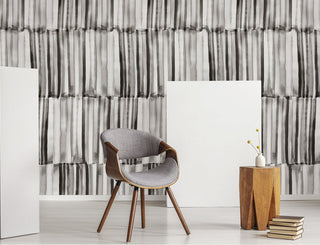
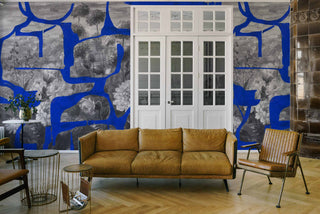
Surface White Water by Wallpaper Projects demonstrates how scale can transform something inherently artistic into an architectural surface.
Created in collaboration with decorative artist Michelle Kesselman, the design originates from hand painted surface textures.
For designers specifying murals, scale should therefore be considered in relation to the architecture rather than independently from it.
3. Design With Light

Colour rarely exists independently of light As daylight moves through an interior, surfaces reveal different qualities. A finish that appears quiet in the morning can become dramatically reflective in the evening.
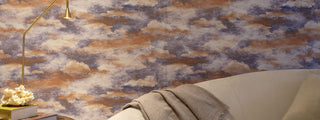
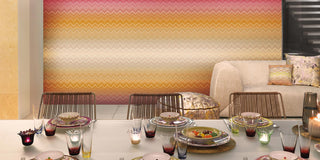
This is particularly important when specifying metallic wallcoverings like Solar Gunmetal Metallic by Emma Hayes that was inspired by the intersection of light, sound and colour. Its painterly transitions evoke shifting light patterns while the gunmetal metallic surface introduces another variable into the composition.
Rather than demanding attention through a conventional motif, Solar creates atmosphere through movement and reflected light.
For professional interiors, designers can consider where natural light enters the room, how artificial lighting will interact with the wall after sunset, and how the surface will be experienced from different viewpoints.
The wall does not remain visually static throughout the day.
4. Let Atmosphere Do Some of the Storytelling

Some of the most memorable film environments establish mood before we consciously understand why.
Interior designers can work with that same principle where tone, reflectivity, pattern density and material can create an emotional response without relying on an obvious decorative statement.
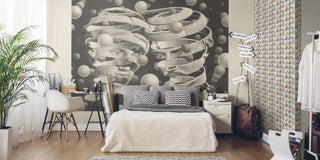
Atmospheric Haze Metallics Silver by Coordonné offers a useful example. Its graphic surface creates visual rhythm while the metallic finish adds a polished quality that changes with the surrounding light. The result demonstrates how wallcovering can operate somewhere between pattern and atmosphere.
In a restrained interior, this kind of surface can provide depth without overwhelming the architecture. In a more expressive room, it can become part of a larger conversation between reflective materials, artwork and furnishings.
5. Treat the Wall as a Work of Art

A wall does not have to begin as a background. It can be the starting point. Object Study X by Wallpaper Projects demonstrates this particularly clearly.
The collection was developed in collaboration with artist and designer Alexis Stiteler, whose original works are hand drawn on textiles and paper using aqueous paints.
The wallcoverings can be customized, allowing compositions to be strategically placed according to the dimensions and architecture of an interior.
Instead of selecting wallpaper after the major design decisions have already been made, the wallcovering can establish the composition from the beginning. Furniture can respond to it and the lighting can reveal it. Materials can complement or deliberately contrast it.
The wall becomes part of the artistic direction of the room rather than its final decorative layer.
When a Room Becomes a World of Its Own
The connection between art, film and interiors ultimately comes down to experience.
A beautiful surface can slow the eye. A shift in scale can change our perception of a room. Light can reveal something in the evening that went unnoticed during the day.
The 2026 LACMA Art+Film Gala celebrates creatives who remind us how powerful visual storytelling can be. For designers, that same principle offers permission to think beyond decoration and consider the wall as an active part of the experience.
Discover Wallcoverings That Transform the Room
At NewWall, wallcovering is an opportunity to introduce art, materiality and imagination into the architecture of an interior. From artist collaborations and hand painted inspired surfaces to atmospheric metallics and made to measure murals, discover designs that give the wall a point of view.